
Sand Dunes
A Nationally Important Habitat
The Sefton Coast supports the largest coastal dune system in England (around 2,100 ha) and one of the most biodiverse .
Much of its wildlife depends on dynamic conditions, including mobile dunes, bare sand, and seasonally flooded slacks formed by wind erosion.
Loss of Bare Sand and Increasing Stabilisation

Like many dune systems in Britain and Western Europe, the Sefton dunes are becoming increasingly stabilised. Bare sand is being lost as coarse vegetation and scrub spread.
Aerial photography shows that more than 80% of bare sand has disappeared since 1945 . This change is driven by several factors, including:
- natural succession
- planting of non-native trees and shrubs
- reduced grazing, particularly by rabbits
- past management to stabilise dunes
- nitrogen deposition from agriculture and industry
- climate change extending the growing season
Changes to Dune Slack Habitats
Human influence on dune stability has a long history, but recent decades have seen a marked decline in mobile and open dune habitats.
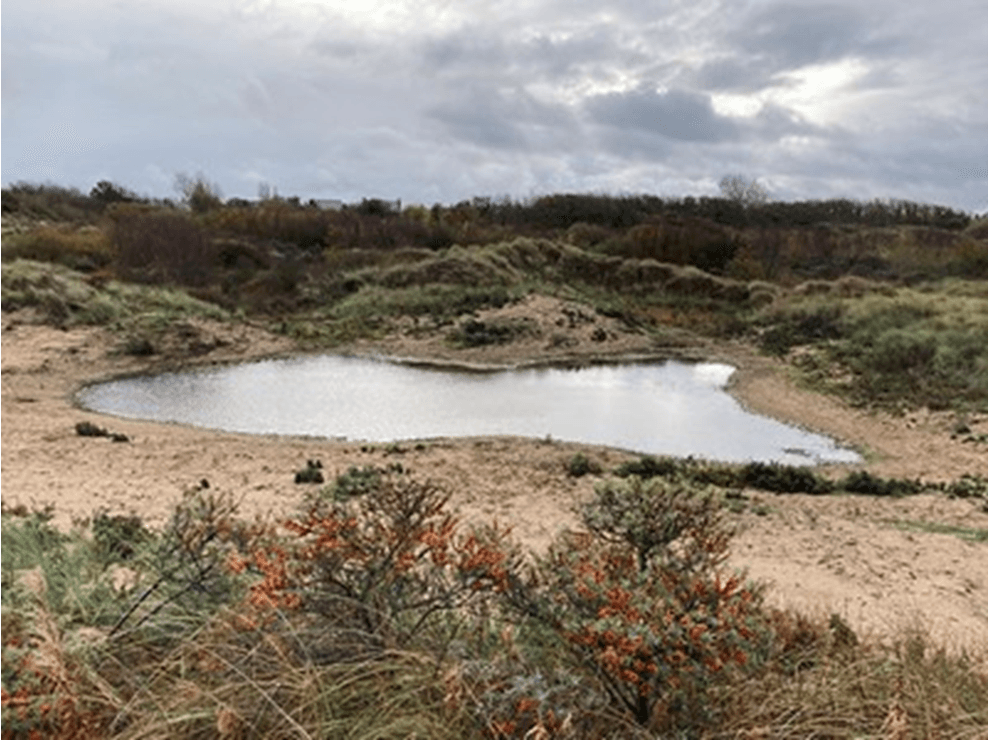
This has reduced the formation of new dune slacks, leading to older, less diverse habitats. Newly formed slacks can be highly species-rich—research at Birkdale showed a 42% increase in species over 20 years.
However, many slacks are now being invaded by scrub, particularly Sea Buckthorn, Downy Birch and Grey Willow. In total, around 38 native and non-native plant species have been identified as invasive, including Japanese Rose and Traveller’s Joy.
Areas of Ongoing Change
An important exception to vegetation overgrowth is the ‘Green Beach’ between Birkdale and Ainsdale, which has developed since 1986. This area supports species-rich early-stage habitats, particularly nearer Ainsdale.
Elsewhere, some open sand features remain, such as the Devil’s Hole blowout at Ravenmeols—the largest of its kind in Britain. However, even this is gradually developing into scrub without regular management.
Coastal Erosion and Accretion
At Formby Point, frontal dunes have been eroding since 1906, with losses averaging around 4 metres per year along a 5 km stretch. This has reduced open sandy habitats and pushed dunes inland against the conifer plantations, creating ‘coastal squeeze’.
While new dunes are forming to the north and south, erosion continues at Hightown.
Recreational Pressures
Recreational use of the coast has increased significantly. Some disturbance can benefit species such as sand lizard, but heavy trampling damages vegetation and destabilises dunes.
Light to moderate trampling can help maintain short vegetation and open sandy paths. In some areas, these paths now provide the only remaining bare sand habitat, which is vital for many invertebrates.
Dog walking has also increased, even in quieter areas. Poorly controlled dogs can disturb wildlife and livestock, while waste may enrich soils and alter vegetation. There is also concern about flea-treatment chemicals affecting aquatic invertebrates in dune slacks.
