
Explore Our Changing Coast: A Historical Journey
Discover significant events shaping the Sefton Coast, from the 1600s to early 2000s, highlighting environmental and human influences.
Coastal Change: History and Ecology
A Coast That Has Always Changed
The Sefton Coast has never been static. Over hundreds of years, shifting sands, changing habitats, and human activity have shaped the coastline. People have been influencing this area since at least the 1300s.
Early Use of the Coast (1600s)
By the 1600s, the coast was regularly used for grazing livestock and managing large rabbit warrens. These activities created wide areas of bare sand. Marram grass was planted to help stabilise the dunes during this time.
Planting Woodlands (Late 1800s)
Before the late 19th century, woodland was almost absent along the coast. Large pine plantations were then introduced as a timber crop, and sea buckthorn was later planted to shelter young trees.
20th Century Onwards
Since the 1930s, natural coastal processes, urban development, increased recreation, climate change, and invasive species have transformed the Sefton Coast. The landscape today looks very different from how it would have appeared even a few hundred years ago.
Ongoing Human Influence
Continuous human activity and the growing effects of climate change have created an unstable ecosystem that requires active, careful management. This is not a place where “re-wilding” or leaving nature alone is possible. Without intervention, important dune habitats would quickly be overwhelmed by invasive scrub such as sea buckthorn and Japanese rose. The pine woodlands would also struggle to support red squirrels.
Managing Our Special Coast
Nature conservation here must focus on protecting rare species and habitats while also adapting to environmental change and supporting the needs of local communities.
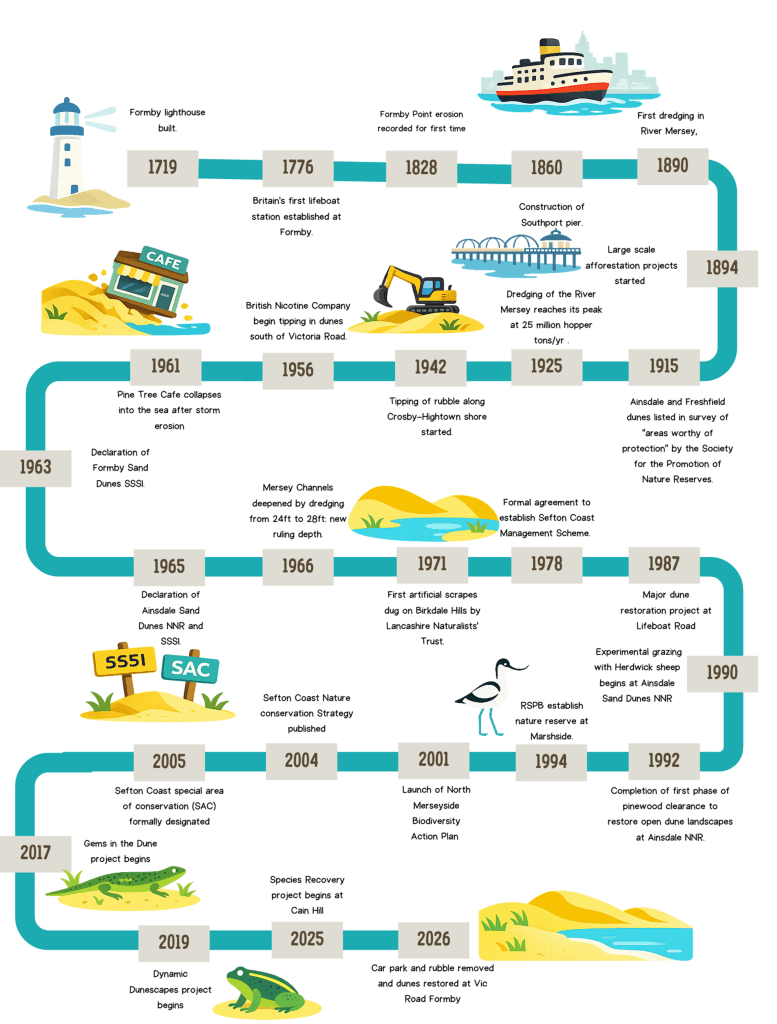
1600s–1700s: Early Management & Natural Events
- 1630s – ‘Hawslookers’ appointed; early controls on marram grass use (1637 fines recorded).
- 1667 – Rabbit warrens established at Formby; early dune land‑use management.
- 1719 – Formby landmark (lighthouse) built.
- 1720 – Major coastal inundation floods 660 acres and destroys homes
- 1727 – First recorded fine for marram cutting.
- 1739 – Sandstorm buries the village of Ravenmeols
- 1757 – Marram planting overseen by ‘Starr Setters’; compulsory in new leases.
- 1779 – Alt Commissioners appointed; floodgates constructed under the Alt Drainage Act.
1800s: Engineering, Erosion & Development
- 1828 – Formby Point erosion formally recorded
- 1835 – First promenade and seawall built at Southport.
- 1860 – Southport Pier constructed.
- 1880 – Dumping of refuse begins in Liverpool Bay
- 1887–1894 – Large‑scale dune afforestation begins.
- 1890 – First dredging of the River Mersey.
- 1896 – Sewage sludge dumping begins in Liverpool Bay.
Early–Mid 1900s: Recognition & Protection
- 1915 – Ainsdale and Freshfield dunes listed as worthy of protection.
- 1919–1920 – Widespread concern over accelerating coastal erosion
- 1936 – River Alt diverted by training wall.
- 1942 – Rubble tipping begins along Crosby–Hightown shore.
- 1956 – Southport Sanctuary designated (one of the UK’s first).
- 1958 – Formby Coast Protection Order made.
- 1963 – Formby Sand Dunes declared SSSI.
- 1965–1966 – Ainsdale, Southport dunes designated NNRs/SSSIs.
1970s–1980s: Active Coastal Management
- 1970 – Natterjack toad conservation begins at Altcar
- 1977 – Major storm surge (6.11 m above O.D.).
- 1978 – Sefton Coast Management Scheme established.
- 1979 – Altcar Sand Dunes and Foreshore designated SSSI.
- 1982–1985 – Ribble and Alt estuaries designated SPA and Ramsar sites..
- 1987 – Major dune restoration and experimental beach barriers.
1990s–Early 2000s: Integrated Conservation
- 1990 – Severe storm surge (6.3 m above O.D.).
- 1991 – Coast‑wide SSSI notifications completed
- 1993 – Beach Management Plan introduced.
- 1995 – Sefton Coast proposed as Special Area of Conservation; EU Life funding secured
- 1999 – Sefton Coast Forum established.
- 2000 – Sefton Coast SSSI formally notified
- 2001 – Sefton Coast Partnership and website launched..
Mid 2000s–Present: Conservation & Restoration
- 2004 – Sefton Coast Nature Conservation Strategy published.
- 2005 – Sefton Coast Special Area of Conservation (SAC) formally designated.
- 2017 – Gems in the Dunes project begins.
- 2019 – Dynamic Dunescapes project begins.
- 2025 – Species Recovery Project begins at Cabin Hill.
- 2026 – Car park and rubble removed and dunes restored at Victoria Road, Formby.